When you study the B.A. American Studies in Frankfurt, you are part of a lively academic community in which events happen every semester, from individual guest lectures to workshops and conferences. Watch, learn, and participate through your questions.
Guest lectures by distinguished scholars broaden your academic horizon, and wider-ranging lecture series deepen your understanding of key issues.
Conferences and workshops give you insight into key academic practices and current developments in American Studies research.
Participation in these events comes with the possibility of obtaining credit for the B.A. program. But more importantly, they are where academic life happens, and where knowledge is made present and relatable.
Announcements about upcoming events can be found on the department’s news website
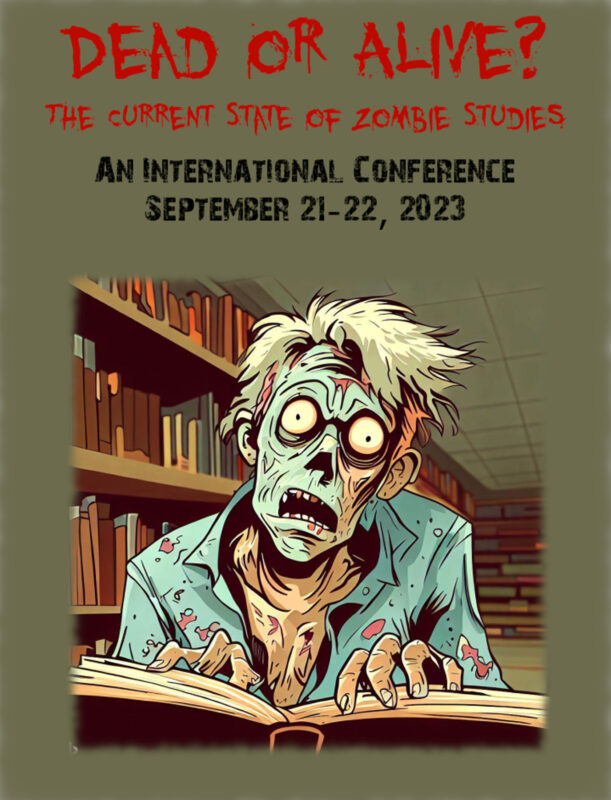
The Current State of Zombie Studies
September 21–22, 2023
International Conference
Organized by Marlon Lieber and Tim Lanzendörfer
What is the current state of zombie studies, and what of the zombie? The conference Dead or Alive? aimed to reflect on the figure of the zombie today, its power as a marker of contemporary anxieties, as a fully commercialized genre staple, as a symbolic means of resolving real contradictions, as a touchstone of popular culture, and more. What work can the zombie do in the contemporary, and how important does it remain in culture? In asking these questions, the conference brought together not so much singular case studies but rather developed broader arguments about the zombie figure’s valences, the ways in which it still does (or does not) appear a useful means of exploring the contemporary situation, or can help us understand our pasts.
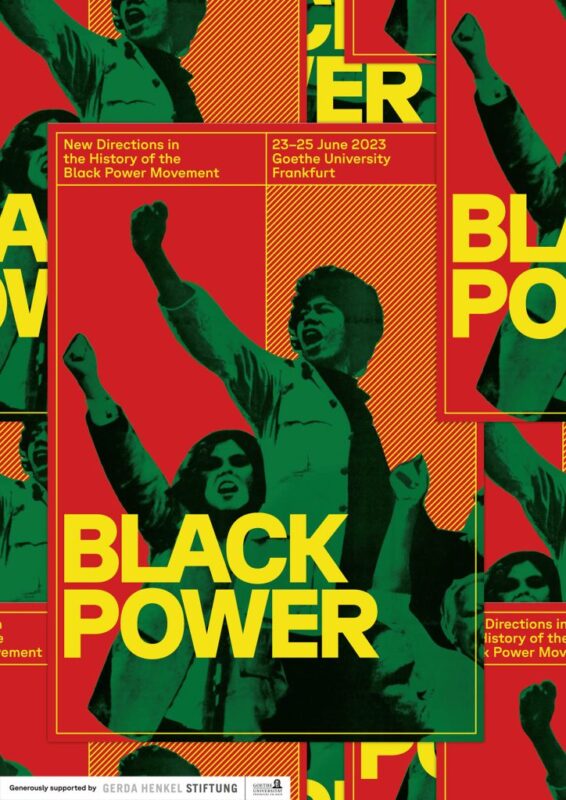
June 23–25, 2023
International Conference
Organized by Simon Wendt and Gloria Fears-Heinzel
The first two decades of the 21st century saw a plethora of new studies on the history of the Black Power movement. Taken together, these studies revised one-dimensional interpretations of the movement, exploring its roots, the significance of local organizing, African American women’s contributions, the movement’s political impact, and its radical internationalism. Building on this foundation, this conference brings together a new generation of American, British, and German historians who shed fresh light on the Black Power movement’s complex history. While some of their contributions revisit topics that have long been of interest to historians of the era—African American women, education, and the movement’s global impact—others open up new historiographical trajectories, including the role of religion and collaborations between Black Power organizations and LGBTQ activists. This conference sought to help us better understand both the Black Power movement’s history and its legacy.
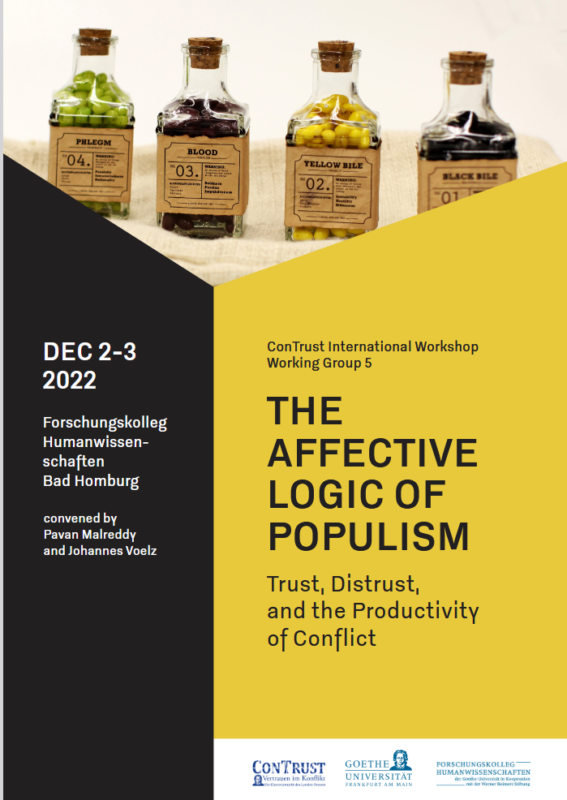
December 2–3, 2022
International Conference
Excellence Cluster Initiative “ConTrust: Trust in Conflict”
Forschungskolleg Humanwissenschaften Bad Homburg
Organized by Pavan Malreddy and Johannes Voelz
This conference assembles leading international scholars with expertise in political emotions and affects. Coming from a broad range of disciplines, including cultural geography, social psychology, sociology, philosophy, and political science, the speakers will explore the affective dimensions of the constellations of trust and distrust at work in contemporary populism and authoritarianism. Starting from the premise that populism and authoritarianism share global family resemblances that have to be contextualized with regional and historical specificity, the conference facilitates a debate between perspectives from the Global South and North.
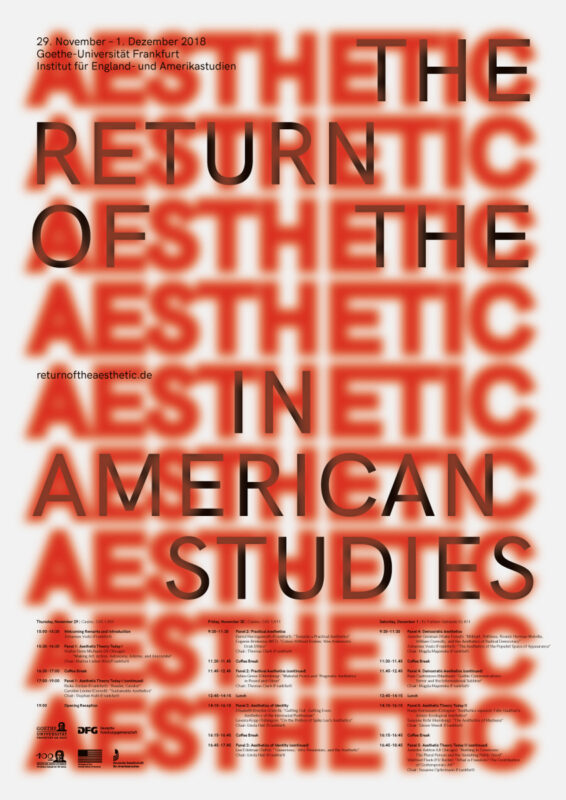
November 29 – December 1, 2018
International Conference
Organized by Johannes Völz and the Department of American Studies
Aesthetics is coming back.
For the past forty years, scholars across the humanities have routinely rejected aesthetic inquiry as ideological, exclusionary, or politically quietist. In American Studies particularly, this anti-aesthetic attitude has congealed into the field’s common sense. Only in the most recent past have several scholars begun to pay renewed attention to the aesthetic and to rethink its relationship to the spheres of the social, economic, and political. “The Return of the Aesthetic in American Studies” critically takes stock of recent returns to the aesthetic and extends their scope.
Watch interviews with our conference speakers in our Youtube Channel
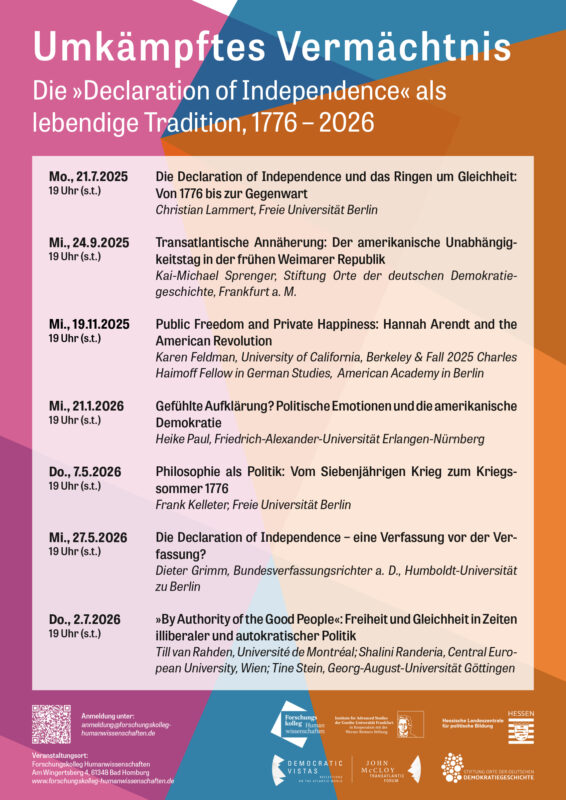
Contested Legacy: The ‘Declaration of Independence’ as a Living Tradition, 1776–2026
2025–2026
John McCloy Transatlantic Forum Lecture Series
Organized by Johannes Voelz and Forschungskolleg Humanwissenschaften
The American Declaration of Independence of July 4, 1776, is the founding document of the first modern democracy. It articulated principles such as liberty, self-determination, and equality, which a few years later were given a political and legal framework in the Constitution of the United States of America. In 2026, the Declaration will mark its 250th anniversary. The John McCloy Transatlantic Forum at the Forschungskolleg Humanwissenschaften takes this occasion—especially against the backdrop of current developments in the United States—to devote an interdisciplinary lecture series to the afterlives and present-day relevance of the “Declaration of Independence.”
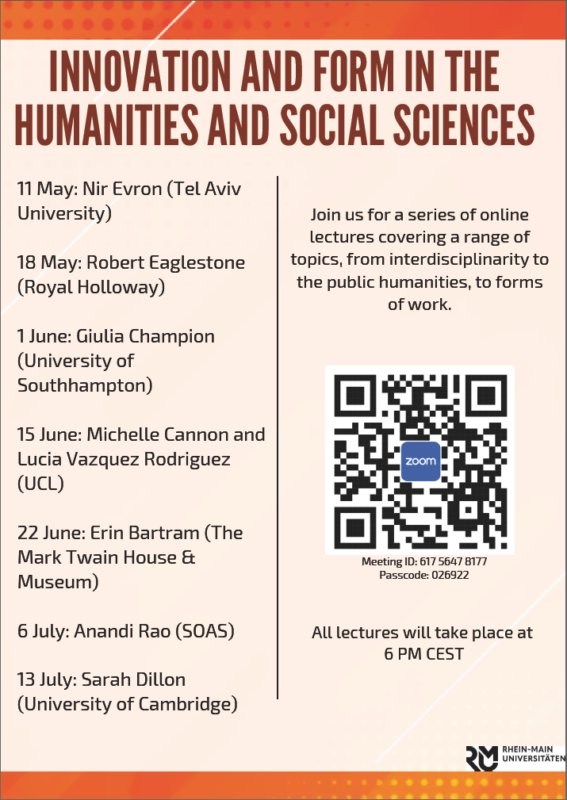
What the Future Holds for the Humanities
2025–2026
Online Lecture Series
Organized by Tim Lanzendörfer, with James Dowthwaite, Roslyn Irving, and Torsten Kathke (Mainz)
The futures of the humanities are a topic of considerable contemporary discussion and urgency, raising questions around their practices and institutional histories. This lecture series directs attention toward an understudied element of this future: the concrete forms in which humanities work is done. Often simply dubbed “outputs” or understood to be inherently but silently part of academic work practices, forms structure the nature of academic work through their affordances. The past decades have seen the arrival of a number of promising and innovative forms in which to do humanities work–such as podcasts and social media–without a decline in the importance of persistent historical forms, such as the monograph or the essay. Against this backdrop, the series enables local and translocal debate around persistent and innovative forms.
Watch lectures from this series online at the Key Forms website.
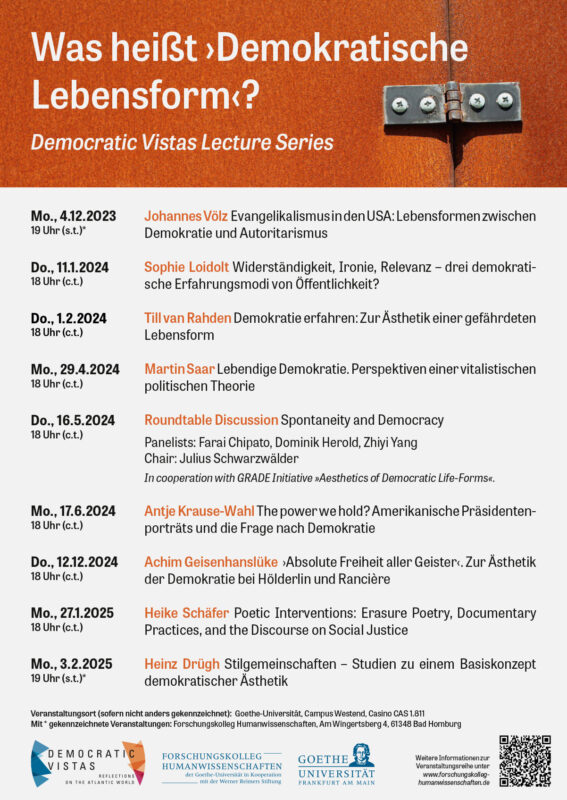
What is Called ‘Democratic Way of Life’?
2023–2025
Lecture Series of the Research Focus “Democratic Vistas,”
Organized by Johannes Voelz
What does “democracy” mean? Does it refer to a political system, a form of governing? Or does “democracy” designate a form of living together that shapes everyday life and is grounded in the political, social, and cultural dimensions? The research focus “Democratic Vistas: Reflections on the Atlantic World” at the Forschungskolleg Humanwissenschaften takes up this question as its programmatic concern. It examines what it means to understand democracy as a “form of life.” In a lecture series spanning three semesters, researchers from the network present case studies from a variety of disciplinary perspectives through which a concrete understanding can be gained of what “democratic form of life” might be taken to mean.
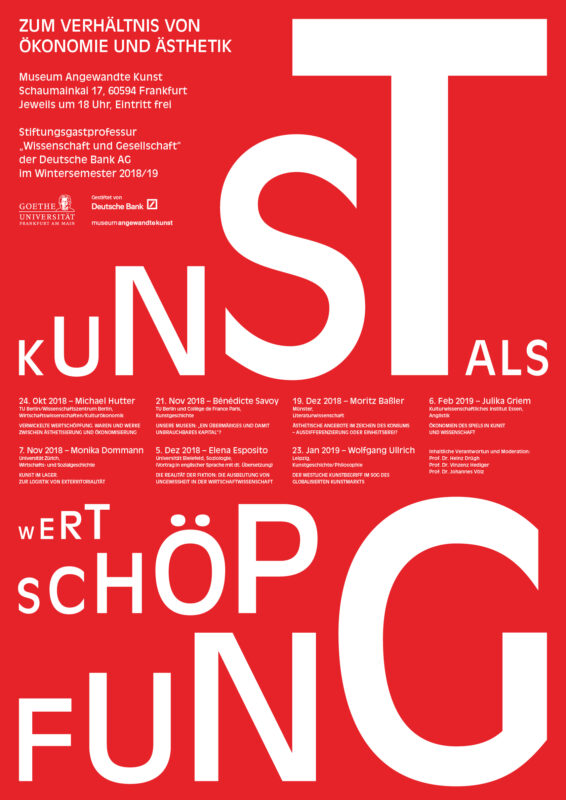
Art as Value Creation: On the Relationship between Economy and Aesthetics
October 2018 – January 2019
Deutsche Bank Visiting Professorship ‘Science and Society’
Museum for Applied Arts, Frankfurt
Organized by Heinz Drügh, Vinzenz Hediger, and Johannes Voelz
Instrumentally rational profit-seeking on the one hand, purposeless enjoyment coupled with critical reflection on the other: economics and art, economy and aesthetics, seem to stand in an irreconcilable opposition. But what if art does not merely critique the economization of everyday life or serve as compensation for the stress of economic life, but is itself permeated by economic logic and even contributes to economic development?
These questions are explored by the interdisciplinary lecture series “Art as Value Creation: On the Relationship between Economy and Aesthetics,” held within the Deutsche Bank Visiting Professorship ‘Science and Society.’ Renowned experts from economics, art history, and cultural studies reconsider the relationship between economy and aesthetics in seven public lectures at the Museum Angewandte Kunst.
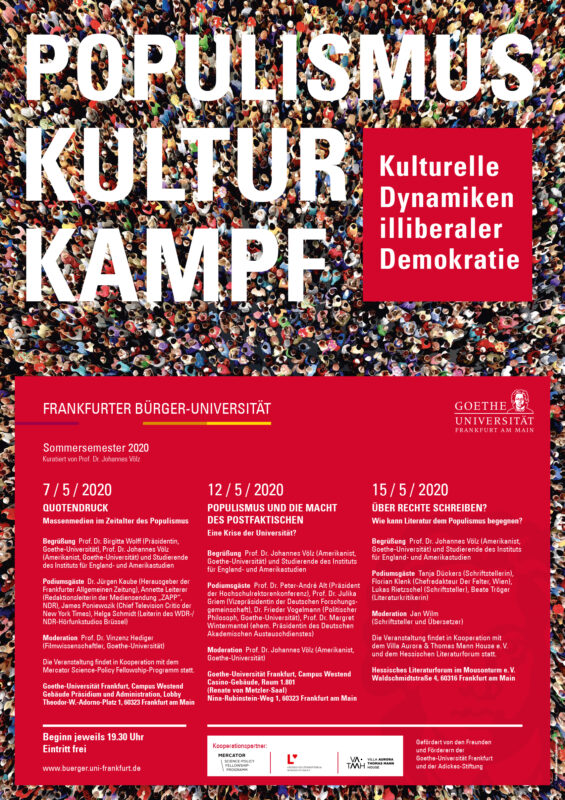
July 2021
Bürgeruniversität (Goethe University Outreach Program)
Organized by American Studies Students and Johannes Voelz
The populist movements of the last decade are not a purely political phenomenon. Political conflicts today increasingly take the form of culture wars, in which the most diverse facets of everyday life become markers of political affiliation. At the same time, civil-society institutions—from the media and universities to the literary field—are turning into arenas for new forms of political contestation. This is where the series of events co-conceived by students of the Institute of English and American Studies comes in: only when we also consider cultural dynamics can we grasp how populist currents have been able to spread across the globe.
Watch the panel discussions on Youtube:
Event 1: „Quotendruck. Massenmedien im Zeitalter des Populismus“
Event 2: „Über Rechte schreiben? Wie kann Literatur dem Populismus begegnen?“
Event 3: „Populismus und das postfaktische Zeitalter. Eine Krise der Universität?“